


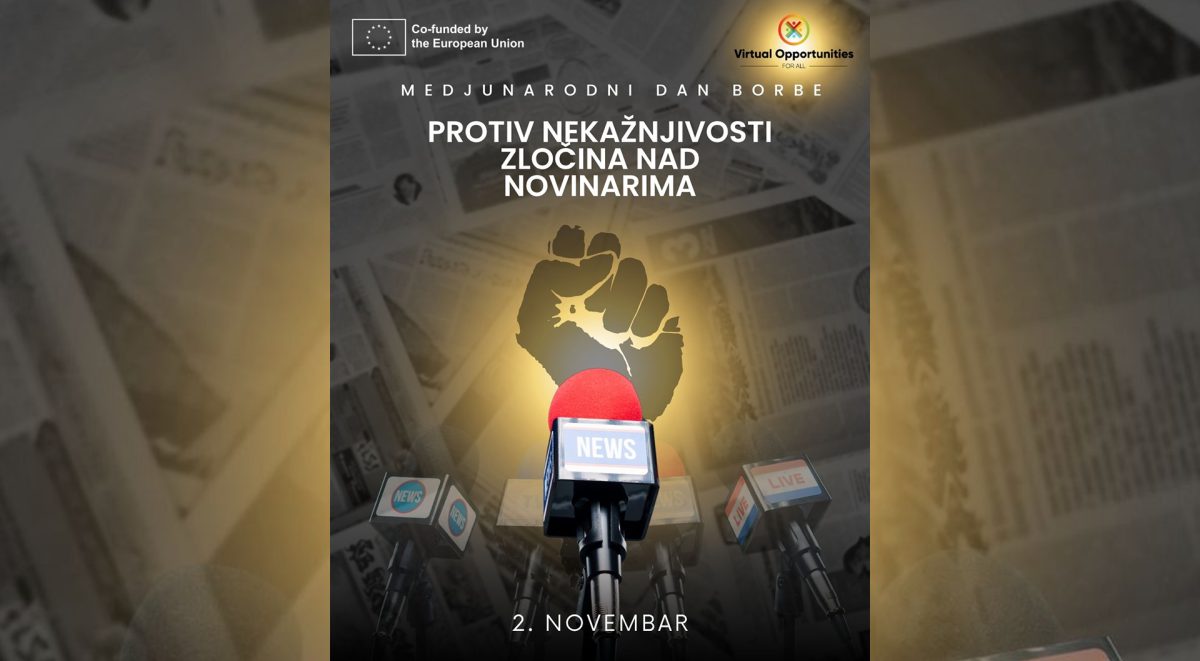
Every year, on November 2, the world marks the International Day to End Impunity for Crimes against Journalists. This date serves not only as a reminder of the journalists who have been killed or attacked but also as a mirror reflecting the state of media freedom in each country. In Serbia, that mirror has for years revealed deep cracks — showing pressure, threats, intimidation, and attempts to silence every voice that dares to speak outside the ruling narrative.
Although freedom of expression is often discussed publicly, the reality on the ground paints a different picture. According to data from the Independent Journalists’ Association of Serbia (NUNS), since the beginning of 2025, there have been over 120 attacks and pressures on journalists. Many have been subjected to brutal online campaigns, targeted by tabloids, and some have even experienced physical assaults.
The Journalists’ Association of Serbia (UNS) reported 111 cases of threats, pressure, and attacks on journalists and media workers during 2024, including 13 physical attacks, showing that violence against media professionals remains persistent. Even more alarming, in the first five months of 2025 alone, 16 physical attacks were recorded — the highest number in the past five years. Particularly concerning is that independent and critically oriented journalists are most often the targets — those who ask questions about corruption, abuse of power, and the links between politics and crime. In addition, female journalists are frequently subjected to gender-based violence and misogynistic attacks, both in public and online spaces.
The media landscape in Serbia has become a battleground of sharp polarization. On one side are pro-government media with almost unlimited access to airwaves and resources, while on the other side are small, independent outlets struggling daily under financial and political pressure, direct threats, and censorship. Campaigns against journalists from outlets such as KRIK, BIRN, N1, Danas, and CINS reveal how dangerous it is to persist in seeking the truth in a country where power and interest often stand above the law.
Institutional protection is almost nonexistent. Many cases of threats and attacks on journalists remain unsolved for years, and impunity has become the rule, not the exception. Such a state not only endangers journalists’ safety but also discourages new generations from pursuing investigative journalism — a profession that should be a pillar of democracy, not a risk to one’s life.
As we mark this day of fighting impunity, it is crucial to remember that media freedom is not given — it is fought for and defended every day. Journalists in Serbia are not asking for privileges; they are asking for the right to do their job without fear. A society that fails to protect its journalists will soon be left without truth.
Sources:
-
NUNS: Since the beginning of the year, 125 attacks and pressures on journalists
-
Cenzolovka: In five months, 16 physical attacks on journalists – the highest in the past five years
Project Information
The Youth Empowerment Club 018 (KOM 018) from Serbia is implementing the project “Virtual Opportunities for All” in cooperation with Beyond Borders (Italy), the Red Cross Novo Sarajevo (Bosnia and Herzegovina), and the Youth Center “Perspektiva” (Albania).
The project aims to provide young people with more opportunities to learn and connect in virtual spaces. It is based on the EU’s strategic and policy frameworks supporting new and innovative ways to improve youth digital competences, create virtual and safe spaces for youth participation, and promote positive European and democratic values among young people in the Western Balkans and the EU. The project also focuses on developing tools and methodologies for post-COVID-19 recovery in the youth sector.
The project is being implemented from 01.07.2023 to 30.06.2026 in Serbia, Italy, Bosnia and Herzegovina, and Albania, and is co-financed by the European Union under the Erasmus+ Virtual Exchanges with the Western Balkans program.